Announcements

This section serves as a direct communication channel between the journal and its readers and authors. Updates of interest for our users, calls for papers and special announcements will be published here

  • The Journal of Learning Styles is making progress in terms of its impact and scientific standing

    2026-11-01

    The Journal of Learning Styles Makes Progress in Impact and Scientific Ranking

    We are pleased to share with authors, reviewers, readers and the entire scientific community of the Journal of Learning Styles the significant progress the journal has made in its key impact and scientific ranking indicators.

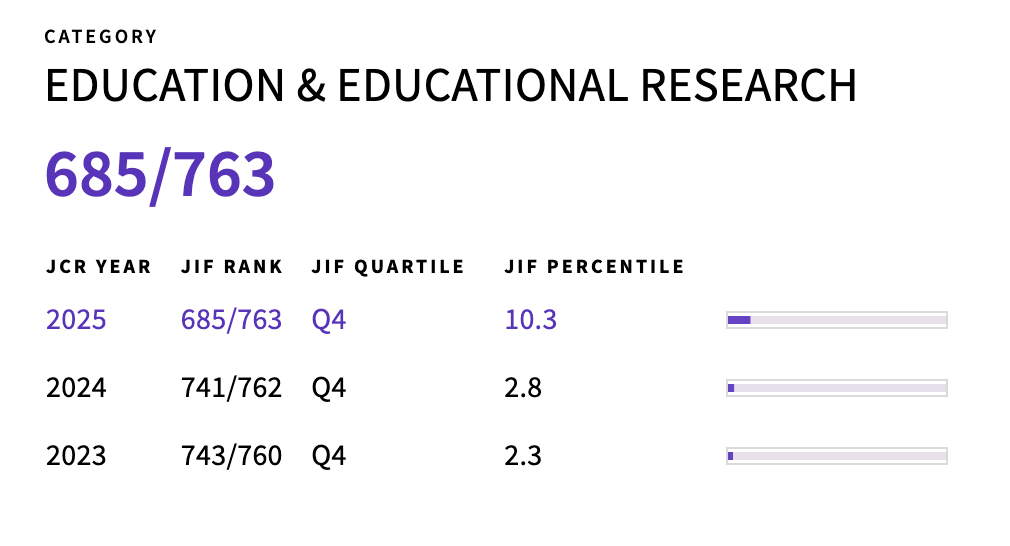
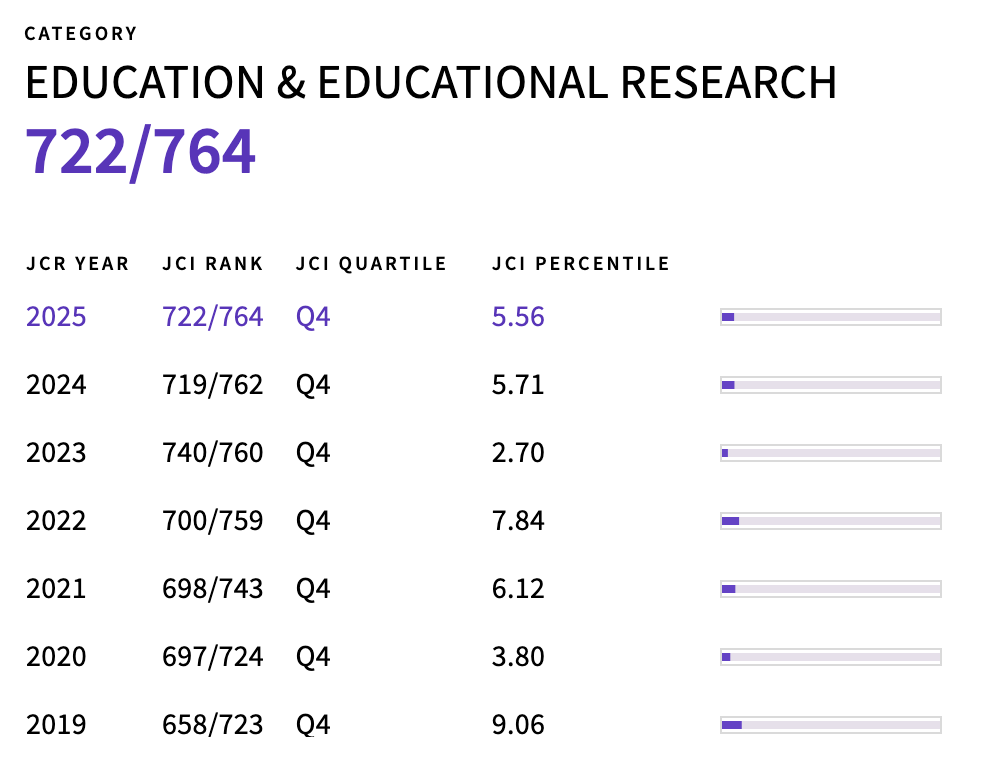
    One of the most significant advances has been in the Journal Impact Factor (JIF) as reported by Journal Citation Reports, where the journal is now ranked in Q4 within the ‘Education & Educational Research’ category and has risen from the 2.8 percentile to the 10.3 percentile in 2025. This development represents a significant improvement in its ranking and reflects the growing visibility and scientific impact of the published articles.

    The progress recorded in Dialnet Métricas is also particularly noteworthy. The impact IDR has risen from 0.33 to 0.61, enabling the journal to move up ten places and significantly strengthen its position in Q2.

    In addition to these results, the journal has been awarded an A1 rating in QUALIS, the highest category in this Brazilian system for the evaluation and classification of scientific publications, managed by CAPES (Coordenação de Aperfeiçoamento de Pessoal de Nível Superior), a body attached to the Brazilian Ministry of Education. 

    Also particularly noteworthy is the visibility achieved in Google Scholar Metrics, where the journal has an h-index of 62 and an i10-index of 327 – indicators that reflect the presence and citation of published works and reinforce the journal’s profile and reach within the academic community.

    In recent years, the REA journal has achieved four milestones:

    1. JCR-JIF: Q4 in Education & Educational Research, with an improvement from the 2.8th to the 10.3rd percentile.
    2. Dialnet Métricas: an increase in impact factor from 0.33 to 0.61, rising ten places and consolidating its position in Q2.
    3. Google Scholar Metrics: h-index of 62 and i10-index of 327, reflecting the visibility and citation of its published output.
    4. QUALIS: A1, the highest category in the Brazilian classification system managed by CAPES

    The new indicators show a very positive and sustained evolution of the Revista de Estilos de Aprendizaje, both in terms of impact and ranking, as well as in visibility and international recognition.

    Regarding the figure you refer to as ‘h-index 62’, if this corresponds to the h-index for the last five years, we can express it as an overall h-index of 62 and an h5 index of 37.

    These achievements, together with the FECYT Quality and the journal’s inclusion in various national and international indexing and evaluation systems, reflect a sustained track record of growth, quality and scientific recognition.

    These are shared achievements. We would therefore like to express our gratitude to the authors, reviewers, readers, editorial team and contributors, whose trust, rigour and commitment enable the *Estilos de Aprendizaje* journal to continue to progress.

    Thank you for being part of this scientific project and for helping to strengthen its quality, visibility and impact.

    Editorial Board of the *Estilos de Aprendizaje* journal


    Read more about The Journal of Learning Styles is making progress in terms of its impact and scientific standing

  • Nuevo número publicado_Volumen 19, Número 39 (Octubre, 2026)

    2026-10-30

    Dear readers, authors and reviewers:


    The Editorial Board of the journal *Estilos de Aprendizaje* is pleased to announce the publication of a new issue of the journal:


    Volume 19, Issue 39 (October 2026)

    Digital and hybrid education in transition: learning, innovation and inclusion


    This issue now includes the selected research articles on open themes, which have been published following completion of the relevant editorial and double-blind peer-review process.


    Over the coming weeks, and until the issue is finalised, articles responding to the Call for Papers on the specific scientific theme, ‘Digital and hybrid education in transformation: learning, innovation and inclusion’, coordinated by the guest editors, will be published:


    João Mattar, Pontifical Catholic University of São Paulo, Brazil

    Cassio Santos, Centre for Digital Literacy and Social Inclusion, Polytechnic Institute of Santarém, Portugal

    Daniela Karine Ramos, Federal University of Santa Catarina, Brazil


    These papers will be published progressively once they have been approved by the REA editorial team and have successfully completed the double-blind peer-review process.


    We hope that the contents of this new issue will be of interest to you and will contribute to further enriching reflection, research and knowledge regarding new learning scenarios.


    Yours faithfully,

    The REA Editorial Board

    Read more about Nuevo número publicado_Volumen 19, Número 39 (Octubre, 2026)
  • Volumen 20, Número 41 (Octubre, 2027) Teaching strategies for teaching cultural heritage in educational settings

    2026-05-02

    Call for Papers - Volumen 20, Número 41 (Octubre, 2027)

    From an etymological perspective, ‘heritage’ refers to an inheritance received from one’s parents (pater-monium) and embodies an aspiration for the permanence of certain elements presumed to have value. In a social context, it refers to a set of assets, in the broadest sense, received from previous generations which must be constantly updated so that, through a process of remembrance and forgetting, they can trigger processes that constitute a collective identity. At this point, it is worth considering its symbolic dimension, which is precisely what constructs the various layers of meaning that allow heritage to be interpreted as a “memory device”.

    In the current climate, as Zygmunt Bauman[1] asserted, the process of learning and the process of forgetting have no chance whatsoever of escaping the “tyranny of the moment”, which demands rapid learning and swift forgetting. New conceptions of the here and now bring about a dissolution of time into a series of disparate and apparent “new beginnings”. In the same vein, Marc Auge[2] discusses the mode of operation of a certain number of images and defines memories and traces as the product of an erosion caused by forgetting, thus producing a tension that orbits between the interpretation of the past and expectations of the future. The author, dissecting the directions of time, identifies “three forms of forgetting”: return, suspension and beginning, each

    associated with the endeavour to reclaim the past, the present or the future, respectively.

    It is within this context that we must situate the debate on learning about cultural heritage, which may well be regarded as a two-way process that broadens the boundaries of life experience and demands constant reinterpretation so as not to fall into either sterile cataloguing or a precarious balancing act over the abyss of novelty. In this consideration of a tense time, the present is revealed as a plane of intersection of various moments or, from a Borgian perspective, as a system of infinite bifurcations of human experience.

    This fragility is heavily influenced by learning, as it proves to be a crucial factor in the management of memory and in a holistic conception of existence. Consequently, the transmission of cultural heritage must enable critical and renewed interpretations that serve as a key to understanding current issues, whilst also broadening the horizons of life experience. From an anthropological perspective, learning has been identified as a distinctive feature of human beings. Edward Hall[3] identified three characteristics of culture: it is not innate, but learned; the various facets of culture are interrelated—if one aspect of a culture is altered, everything else is affected; and it is shared, effectively determining the boundaries of different groups.

    From this perspective, there is a clear need to approach heritage and cultural studies from diverse cross-cutting and interdisciplinary angles capable of connecting fields so that, beyond their mere objectivity, they become arguments that shape historical consciousness. To this end, the journal Estilos de Aprendizaje invites submissions of original articles exploring diverse research, studies and experiences related to the process of learning, interrelationships and their transmission within the field of cultural heritage. Through these various contributions, the aim is to offer a critical perspective

    on the way in which society relates to its heritage and, consequently, how it is able to shape the various moments in time.

    The following thematic areas are proposed:

    • The study of art history and architecture.
    • Critical considerations regarding the teaching of heritage within the academic curriculum.
    • Teaching and methodological innovations in the study of cultural heritage.
    • New tools and alternative resources in heritage education.
    • Strategies for recovering erased imaginaries.
    • Interactions between Heritage, Society and the Cultural Industry.
    • Paradigms in the teaching of literary heritage.
    • The impact of audiovisual studies on the transmission of heritage.
    • Transdisciplinary pedagogical strategies and approaches.
    • Case studies, research projects, innovative experiences.

    Submissions must comply with the journal’s guidelines for authors and may be written in any of the languages accepted by the journal (Spanish, Portuguese and English)

    Submission deadline: 30 May 2027

    Publication: October 2027

    Guest editors

    Ignacio Grávalos Lacambra, San Jorge University, USJ, Spain

    Patrizia Di Monte, Lecturer and visiting researcher at various European universities

    Manuel Sánchez García, Polytechnic University of Madrid, UPV, Madrid

    Read more about Volumen 20, Número 41 (Octubre, 2027) Teaching strategies for teaching cultural heritage in educational settings
  • Volume 20, Number 39 (April, 2027) Innovating to transform: challenges of social justice in music education

    2025-10-27

    Call for Papers: Volume 20, Number 40 (April, 2027)

    Innovating to transform: challenges of social justice in music education

    Music education today faces one of its greatest challenges: contributing to the construction of more just, inclusive and equitable societies. From a critical and transformative perspective, this monograph invites reflection on the role of music and music education as tools for innovation and social justice in the 21st century.

    The aim of this call for papers is to bring together research, experiences and proposals that analyse how music education can become a driver of social change, addressing both the structural challenges and the pedagogical, community and cultural opportunities that emerge in a diverse and constantly changing world.

    The aim is to create a space for dialogue between researchers, teachers and professionals who, from different disciplines and contexts, contribute their views on how to innovate in order to transform, placing social justice at the centre of music education.

    This new issue of the Journal of Learning Styles, to be published in April 2027, will promote the dissemination of pedagogical proposals that address the design, implementation and evaluation of educational resources and teaching experiences based on music and the arts, in all their cross-cutting and interdisciplinary dimensions.

    Therefore, this call for papers seeks to publish research articles, studies, experiences and educational practices that highlight the following guiding themes:

    • Educational innovation and social justice in music teaching.
    • Critical music education: approaches to equity and inclusion.
    • Music and citizen participation: community and transformative experiences.
    • Gender, diversity and social justice in music education.
    • Digital technologies and resources as tools for musical equity.
    • Music education and human rights: foundations and practices.
    • Music as a tool for resistance, resilience and social empowerment.
    • Teacher training from a social justice perspective.
    • Global challenges for music education in vulnerable contexts.
    • New horizons for research in music, innovation and social transformation.

    Information for authors

    Submission of full articles: from 1 October 2026
    Publication guidelines: manuscripts must comply with the editorial guidelines and publication standards of the Estilos de Aprendizaje journal.

    Participation

    Research articles, case studies, pedagogical experiences, theoretical reviews and innovative projects that analyse the intersections between music, innovation and social justice in education will be accepted.

    Deadline: 1 November 2026


    Guest coordinators:

    Cristina Arriaga, University of the Basque Country, Spain.

    Cristina.arriaga@ehu.eus

    Natalia Puerta, University of Valle, Cali, Colombia.

    natalia.puerta@correounivalle.edu.co

    Read more about Volume 20, Number 39 (April, 2027) Innovating to transform: challenges of social justice in music education